
Real County Criminal Court Cases
Three local court levels divide Real County criminal court cases. The 38th Judicial District Court hears felonies and district-level post-judgment matters. The constitutional Real County Court handles its misdemeanor docket under Texas law. The Real Countywide Justice Court keeps Class C and other fine-only matters within its jurisdiction, along with warrants issued on that docket. A search confined to one level can therefore miss a valid case held at another.
The combined County and District Clerk keeps the district and county case files. The official Real County clerk page lists D'Ann Roosa, P.O. Box 750, Leakey, TX 78873, at 830-232-5202 and fax 830-232-6888. Requests may start by phone, email, fax, mail, or at the courthouse counter. The clerk's file can show the charge, bond orders, settings, motions, pleas, judgment, sentence, costs, and appeal notices. Cause numbers identify the case more sharply than a name alone.
The county's clerk page is shown in the image captured from that official source.

Its contact details point a records request to the office that holds both county and district criminal case files.
Real County Courts by Charge
The charge level is the fastest way to choose a Real County court. Felonies go to the 38th District Court. Class A and Class B misdemeanors belong in the Real County Court. Fine-only Class C matters may remain with the justice court or another court named on the citation. Texas punishment ranges may help explain the labels, but the filed charging instrument and final judgment control the actual classification.
| Charge level | Real County court | Possible Texas range |
|---|---|---|
| First-degree felony | 38th District Court | Life or 5 to 99 years; fine up to $10,000 |
| Second-degree felony | 38th District Court | 2 to 20 years; fine up to $10,000 |
| Third-degree felony | 38th District Court | 2 to 10 years; fine up to $10,000 |
| State-jail felony | 38th District Court | 180 days to 2 years; fine up to $10,000 |
| Class A misdemeanor | Real County Court | Up to 1 year in jail, a fine up to $4,000, or both |
| Class B misdemeanor | Real County Court | Up to 180 days in jail, a fine up to $2,000, or both |
| Class C misdemeanor | JP or municipal court with jurisdiction | Fine up to $500 |
Prosecutor review may change a booking label before a case is filed. That is why a Real County court judgment is more useful for the final charge and outcome than the first allegation recorded at intake.
The district clerk's official contact page appears in this image from the Real County District Clerk.
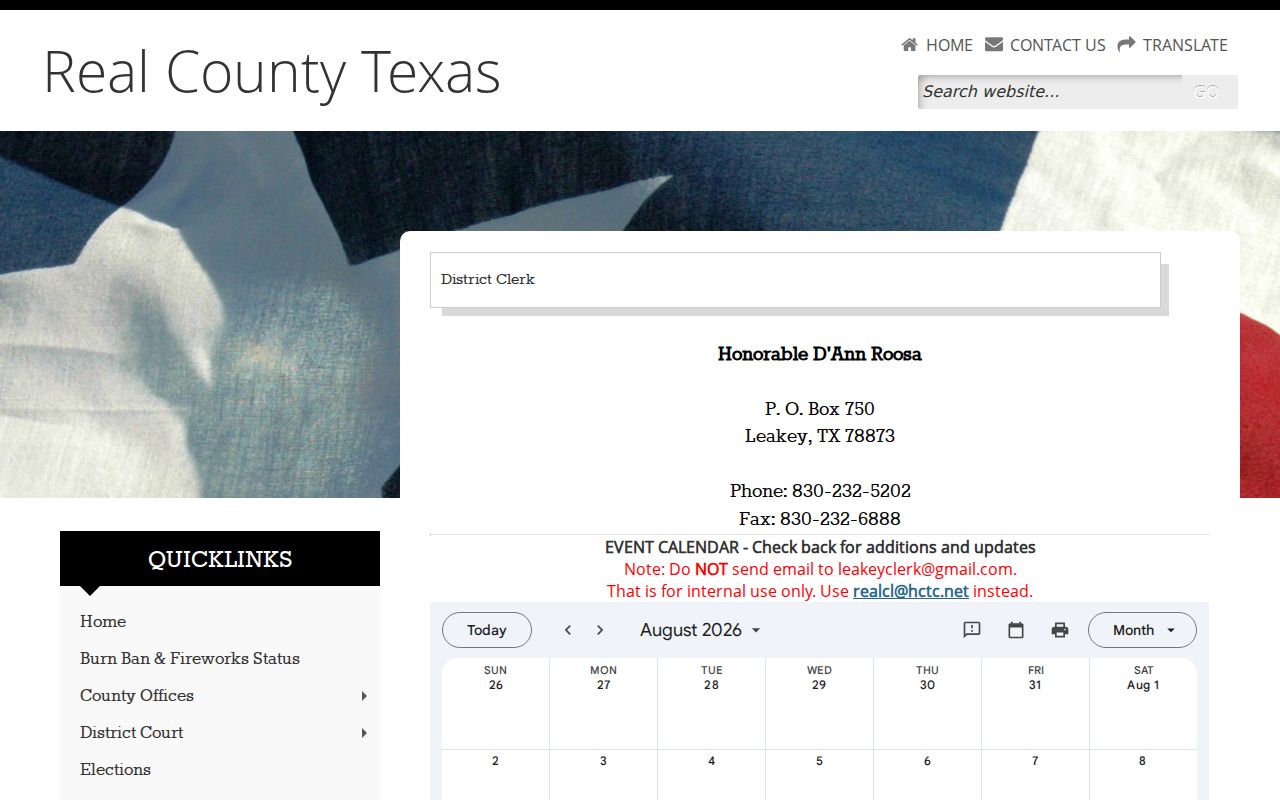
The page confirms the shared clerk channel and the public email used for district criminal case requests.
Searching Real County Case Records
Start the Real County criminal case search with the court most likely to hold the charge. iDocket can provide a free guest first pass for county and district collections, but a candidate result still needs clerk confirmation. No official county page states complete date coverage, archive coverage, or a full public criminal copy-fee schedule. Older records may be paper, archived, or stored off-site.
- Choose the likely court level: district for felony, county for Class A or B misdemeanor, or justice court for its fine-only docket.
- Use the iDocket guest search for a name or known cause number in the Real County county and district collections.
- Call the combined clerk at 830-232-5202, or email realcl@hctc.net, with the full name, approximate filing year, and cause number if known.
- Ask for the docket sheet, charging instrument, bond order, judgment, sentence, and any needed public or redacted documents.
- Confirm whether the file is on-site, paper-only, archived, or off-site. Request an itemized price before ordering plain or certified copies.
| Search field | Use | Required | Real County note |
|---|---|---|---|
| Court collection | Select county or district records | For portal search | The JP docket must be checked on its own |
| Full case name | Find a party record | If cause number is unknown | Use the name as known in the case |
| Cause number | Open or request one file | No | Best identifier when available |
| Approximate filing year | Narrow the clerk's search | No | Useful for older or common-name files |
| Date of birth | Help the clerk distinguish people | Only if requested | Send only through a safe channel the clerk approves |
Do not use the posted real-property recording charge as a criminal copy fee. Real County has not posted its plain or certified criminal-case copy prices in the reviewed official sources.
Real County iDocket Search
The iDocket guest name search is a locator, not a certified court record. It can help recover a candidate cause number in the Real County county or district collection. Advanced details may require an account or subscription. A name hit must be compared with the court, filing year, charge, and disposition before anyone relies on it.
The captured iDocket interface comes from the Real County search entry.

The image shows why an online first pass is useful, while the clerk remains necessary for the filed document and certified outcome.
A no-result is not final. It may mean the query used the wrong court collection, the file is old or paper-only, or the matter sits on the justice court docket. Call both the clerk and the JP if the charge level is unclear. The countywide JP can be reached at 830-232-6630 or jpclerk1@co.real.tx.us.
Inside a Real County Case File
A Real County criminal case file records what prosecutors filed and what the judge did. It does not merely repeat the arrest sheet. The charging document may be a complaint, misdemeanor information, or felony indictment. Later entries can show counsel, hearings, motions, a plea, dismissal, trial, judgment, sentence, costs, community supervision, or an appeal.
| Case number and court | Cause number, court, filing date, case type, status, and judge. |
|---|---|
| Charging document | Complaint, information, or indictment with the filed statute and offense degree. |
| Parties | Defendant, counsel, and State or prosecutor, with protected identities redacted. |
| Docket entries | Filed papers, counsel activity, motions, pleas, hearings, trial settings, and other events. |
| Bond and hearings | Public bond type or amount, hearing date, court, and conditions where available. |
| Disposition and judgment | Dismissal, acquittal, deferred status, conviction, or another recorded outcome. |
| Sentence and costs | Fine, costs, restitution, confinement, supervision term, and credit when recorded. |
No anonymous Real County sample file was exposed online during research. Document availability and certification must therefore be confirmed with the clerk. Public copies may omit victim identities, juvenile information, financial identifiers, or other data made confidential by law.
Real County re:SearchTX Limits
re:SearchTX is a statewide e-filing document environment, but it is not a complete statewide criminal-case lookup. Official statewide reporting says its e-file corpus excludes criminal-case records. It should not replace the Real County combined clerk or the countywide justice court when the goal is to verify a local charge and result.
The image below was captured from the official re:SearchTX portal.
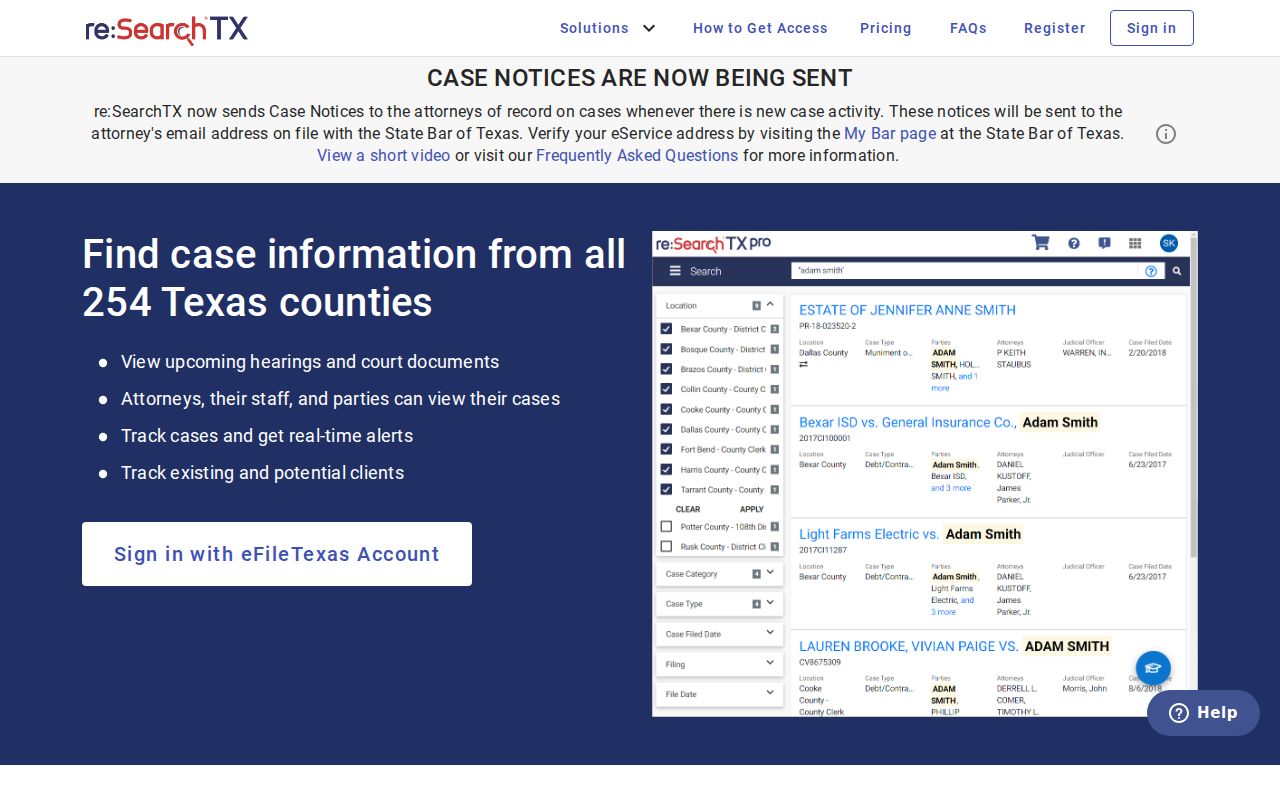
Its statewide scope may look broad, yet the documented criminal-record gap makes direct Real County clerk contact the sound fallback.
A DPS criminal history search answers a different question too. The Texas DPS public product compiles eligible conviction and deferred-adjudication data reported statewide. It is not the local pleading file. A Real County case can contain a dismissal, no-bill, or amended charge that a narrow public name product does not show in the same way.
Real County Case Outcome Terms
Docket terms carry distinct legal results. Reading all of them as “criminal” hides the main fact a case search should find. Check each charge, because one case may contain more than one count and each count can end in a different result.
- No-bill
- The grand jury declines to return a felony indictment.
- Dismissal
- The charge ends without a conviction on that count.
- Acquittal
- The recorded outcome is not guilty.
- Deferred adjudication
- The court defers a guilt finding during community supervision; it is not a final conviction.
- Conviction
- The court enters a judgment or adjudication of guilt.
- Capias
- A court-issued writ directs that the person be arrested.
Deferred adjudication can remain public unless it qualifies for nondisclosure. Likewise, a dismissal does not by itself erase the arrest or booking record. Anyone reviewing their own record should obtain the clerk's disposition before asking DPS to correct a missing or mismatched court result.
How a Criminal Case Moves
A Real County case may begin with an arrest or summons. After an arrest, Texas law calls for magistrate warnings and a bond review without needless delay, generally within 48 hours. That first appearance is not a trial. The prosecutor then decides which charge, if any, should reach court.
Case flow: Charges Filed → Arraignment → Pretrial → Plea or Trial → Disposition → Sentencing
A misdemeanor often proceeds by complaint or information. A felony can go to a grand jury for indictment. Arraignment calls the filed charge and addresses the plea. Discovery and motions follow, then a negotiated plea or trial may produce the judgment. Post-judgment motions and appeals can add later docket entries.
Timing varies by case. The research found no official Real County schedule promising how long each stage takes. Use the latest docket entry and contact the clerk for the current setting rather than estimating from the filing date.
Real County Felony Charging
The 38th Judicial District Attorney prosecutes adult felonies in Real and Uvalde Counties. Christina Mitchell's office reviews felony allegations, works with investigators and victim or witness services, and supports the prosecution path that can lead to a Real County indictment. The district attorney is not the custodian for the full court file. Filed pleadings and the final judgment still come from the clerk.
Charges can change between arrest and judgment. An arresting officer records an initial allegation, the prosecutor chooses what to file, the grand jury may return or decline an indictment, and the court records the end result. Compare the booking label with the charging instrument and the disposition rather than assuming all three match.
Fine-only Real County matters follow another route. The official Countywide Justice Court page is shown below.
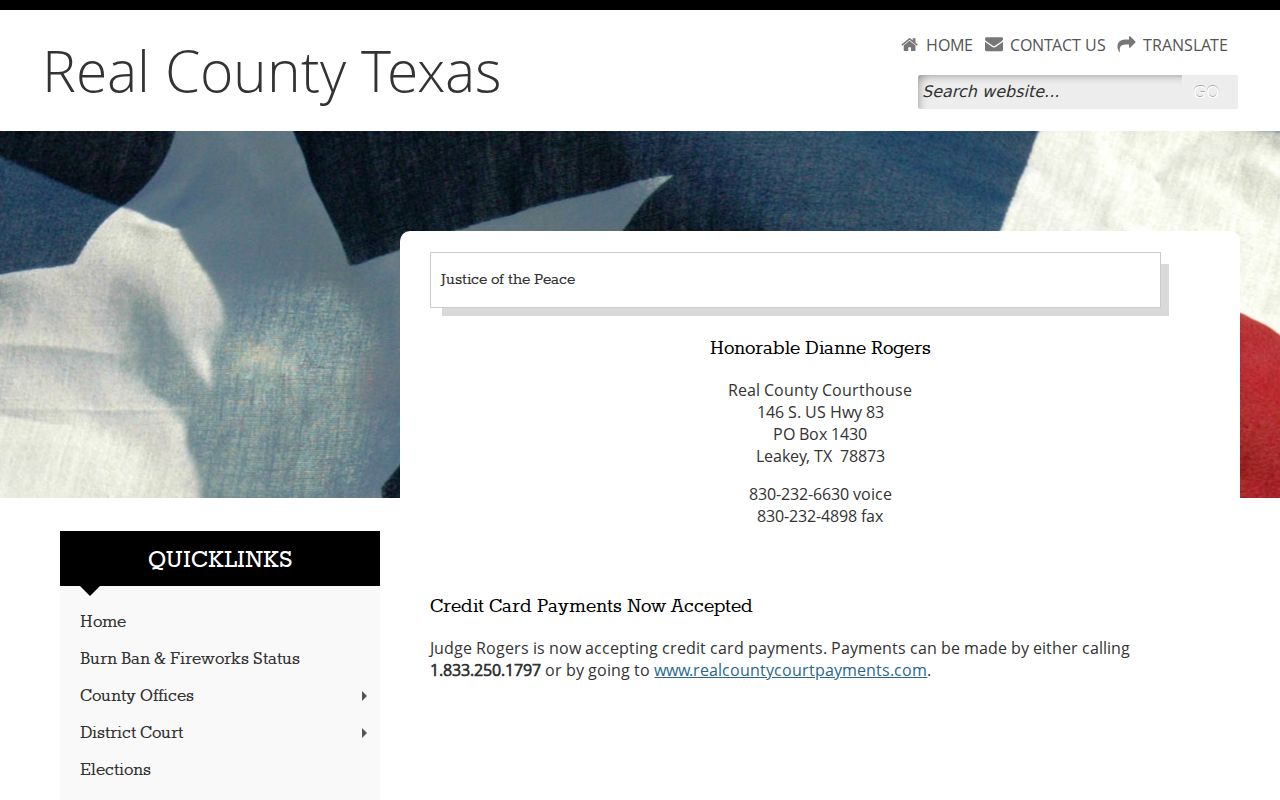
The separate JP contact is a key fallback when county and district searches return no fine-only case or court-issued warrant.
Case Record Access & Restrictions
Filed Real County criminal case records should be requested from the clerk, not treated as sheriff records under the Texas Public Information Act. Administrative judicial records follow Rule 12 of the Texas Rules of Judicial Administration. Court files can still contain redactions or sealed material. Juvenile records, protected victim or minor identities, Social Security numbers, financial account data, and items covered by expunction or nondisclosure may not appear in a public copy.
If a Real County case is absent online, give the clerk the known name, year, cause number, and court. Ask whether the file is sealed, archived, paper-only, off-site, or simply indexed in another court. For a Class C matter, repeat that check with the justice court. For a felony or county misdemeanor, request the docket sheet and final judgment from the combined clerk.
Always request a quote first. Real County posts no criminal copy or certification schedule in the reviewed official sources. The lack of a posted rate does not mean copies are free, and a fee shown for recording a deed does not set the cost of a criminal court document.