
Checking Criminal History in Real County
A useful Real County criminal records search begins by separating court activity, custody, agency reports, and statewide history. The combined County and District Clerk holds filed felony and misdemeanor cases. The countywide Justice Court keeps its own fine-only docket. The Real County Sheriff holds the arrest, offense, and booking layers, while Texas DPS compiles eligible reported events in the Computerized Criminal History system.
The official Real County homepage is the first directory for county offices. It confirms the courthouse-centered structure used for local record access.

This county view helps a reader route a request before calling, mailing, faxing, or visiting the wrong custodian.
- Search the Real County County and District iDocket collections for a candidate case number, then confirm the file with the clerk.
- Call the clerk at 830-232-5202 for felony and misdemeanor files, including older or paper-only matters.
- Contact the Justice Court at 830-232-6630 for its Class C docket and process that may not appear in the other collections.
- For recent custody, use VINELink and call the sheriff at 830-232-5201; request the arrest or booking record separately.
- Use the DPS name search for public Texas conviction and deferred-adjudication data, or fingerprints for a personal self-review.
- Move to TDCJ, PACER, or the Bureau of Prisons only when the record belongs to state prison or federal systems.
Use a full legal name, spelling variants, an approximate year, and a date of birth when the official Real County channel accepts it. A case number, booking date, report number, or tracking control number is even better because common names can lead to false matches.
Real County Courthouse Records Hub
The 1918 courthouse at 146 South U.S. Highway 83 in Leakey remains the working center of Real County criminal court records. County and District Clerk duties are combined under one office, but felony and misdemeanor dockets remain legally distinct. Mail for that clerk goes to P.O. Box 750 rather than the county's general P.O. Box 446. The office shares telephone 830-232-5202 and fax 830-232-6888.
The Texas Historical Commission courthouse record documents the native Tucker Hollow limestone building and its continuing county role.
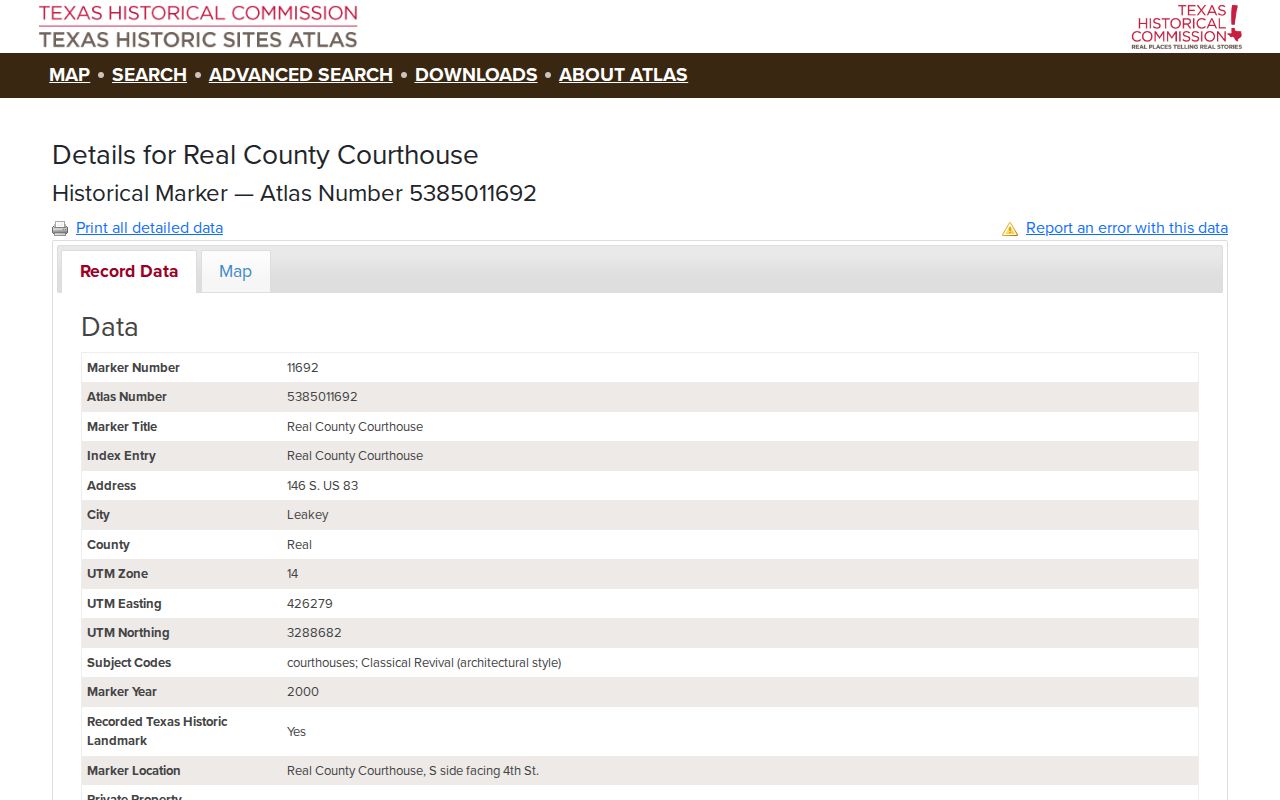
The historic setting matters in practical terms: some Real County files may still require clerk help, an archive check, or a counter visit rather than a complete web search.
County and District Clerk
146 S. U.S. Hwy 83, P.O. Box 750, Leakey, TX 78873
830-232-5202
realcl@hctc.net
Real County Sheriff
P.O. Box 445, Leakey, TX 78873
830-232-5201
Fax 830-232-5102
Countywide Justice Court
P.O. Box 1430, Leakey, TX 78873
830-232-6630
Fine-only docket and related process
Use realcl@hctc.net for the clerk. The district-clerk page specifically warns against an obsolete or internal Gmail address, a small detail that can prevent a request from disappearing into the wrong inbox.
Texas Official Background Checks
The Texas Department of Public Safety Crime Records Division maintains the state's Computerized Criminal History repository. Its public conviction name search returns eligible Texas conviction and deferred-adjudication information reported to DPS. It is not a full list of every Real County arrest, and a name result does not positively prove identity. DPS states that fingerprints are the reliable association method.
For one's own more complete Texas review, schedule FAST fingerprint capture through IdentoGO by IDEMIA. The Texas FAST appointment portal lets a Real County resident check current nearby or mobile enrollment options.
No fixed enrollment center was located in Real County, so ZIP 78873 and the live locator are more reliable than an assumed permanent office.
- DPS online name search: $1 initial search credit; a no-match uses a credit, and card purchases add 2.25% per credit plus $0.25 per transaction.
- DPS offline CR-42: $10 by mail for a name-based Texas check; a broad match set may require more identifiers.
- DPS fingerprint self-review: $15 for the record check plus $10 FAST capture, with identity tied by fingerprints.
- FBI Identity History Summary: $18 FBI fee plus any capture cost for a subject-only national fingerprint product.
- Real County local search: no official county criminal-history product or fee was located; ask the clerk or sheriff about the exact record and copy cost.
Real County DPS Search Fields
The DPS public product works best as a candidate search followed by source verification. Enter a full first and last name, add the middle or maiden name when known, and use a complete date of birth to narrow likely matches. DPS can broaden matching through name positions, a middle initial, birth month and day, and similar-sounding spellings. Initials, nicknames, and partial names weaken the result.
The DPS criminal history instructions explain the search workflow and its matching limits.

The instructions reinforce why a Real County criminal court judgment or Real County fingerprint review should resolve any uncertain name match.
| Field | Use | Search note |
|---|---|---|
| Last Name | Required text | Use the full legal surname. |
| First Name | Required text | Use the full first name, not a nickname. |
| Middle or Maiden | Optional text | Helps separate similar candidates. |
| Date of Birth | Optional date | A complete date narrows best; partial components are accepted. |
| Multi-Entry | Optional workflow | Queues entries before View/Submit. |
| Search | Paid action | The initial action consumes one credit, even with no match. |
Criminal Record Types
Real County criminal records are separate products made at different steps. A sheriff report can describe probable-cause facts and the initial allegation. A jail booking proves intake into custody. A court file shows the charge prosecutors filed and what the judge or jury did. DPS then compiles eligible events reported through the Texas Criminal Justice Information System.
- Arrest and offense reports: agency narratives, dates, locations, initial allegations, evidence, and officer information, subject to release limits.
- Booking and custody records: intake identity, charge at booking, bond, magistrate information, and release or transfer details.
- Court files: complaints, indictments or informations, docket activity, pleas, orders, judgments, sentences, and appeal notices.
- Warrant records: process issued by a court and tracked by law enforcement; some active or sealed material is not public.
- Supervision and corrections records: court judgments, community-supervision actions, TDCJ custody, and parole information held in their own systems.
When the question is what happened after an arrest, the Real County criminal court case file is the source for the filed charge and final disposition. A sheriff record alone cannot answer that question.
Real County Records Without a Jail Roster
Real County does not publish a county-hosted inmate roster, recent-arrest page, booking gallery, or stable jail profile. The sheriff instead links VINELink for participating custody status and notification. That is a current-status aid, not a complete historical arrest search, so a no-result does not establish that no Real County booking occurred.
Use VINELink first for current custody, then telephone the sheriff for confirmation and the request route to a public booking sheet or arrest report. If a sentence moved the person into state prison, change systems to the TDCJ Online Inmate Search. Federal custody belongs in the Bureau of Prisons locator. The dedicated Real County arrest lookup gives the full local channel sequence.
The Real County Sheriff's Office app offers tips, crime reporting, alerts, news, and other public-safety features. It does not advertise an inmate, warrant, records-request, or case-status search. The difference is important because an app report is not a formal request for an existing document.
The official Real County contact directory supplies the courthouse and office routes that fill gaps left by the sparse sheriff website.
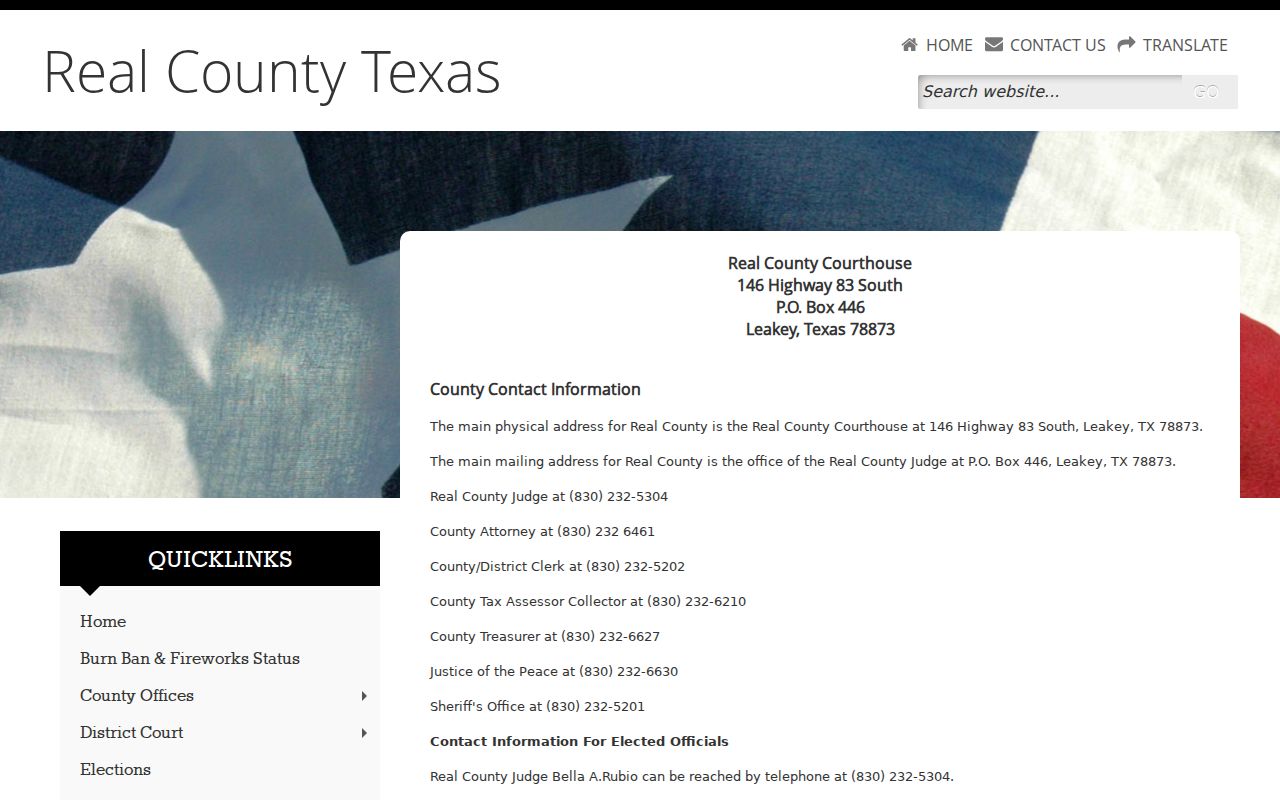
This directory is the practical fallback when an online custody or case tool does not cover the record being sought.
Inside a Real County Criminal Record
A complete Real County criminal record can contain several identifiers and event layers, but public Real County versions omit or redact protected data. A tracking control number can link an arrest cycle to prosecutor and court reporting. The cause number identifies a court case. The Texas SID and FBI or UCN identifiers serve broader identity and reporting functions. None should be confused with a booking number created for local intake.
| Name and identifiers | Legal name, aliases, birth information, physical descriptors, SID, FBI or UCN, fingerprints, and agency control numbers where authorized. |
|---|---|
| Arrest and booking | Arrest date, agency and ORI, tracking number, initial charge, book-in time, booking number, bond, and release or transfer. |
| Prosecutor segment | Accepted, changed, or rejected charge and the cause number used for a filed case. |
| Court outcome | Court, cause number, disposition date, conviction or deferred status, sentence, fine, confinement, and supervision terms. |
| Custody and supervision | Institution intake and release, community supervision, or parole information when reported and public. |
| Protected data | Social Security numbers, financial data, juvenile information, victim identity, and confidential criminal history are withheld as law requires. |
- Disposition
- The recorded outcome of a charge or case.
- Deferred adjudication
- A Texas outcome that defers a finding of guilt during community supervision; it is not a final conviction but may remain public.
- No-bill
- A grand jury decision not to indict on the presented charge.
- Expunction
- A court-ordered Texas remedy that can require covered records to be destroyed or returned under Chapter 55A.
- Nondisclosure
- An order that restricts ordinary public dissemination while allowing access by authorized agencies.
Real County Criminal Reporting Gaps
A Real County charge can change as it moves from the arresting officer to the prosecutor, grand jury, and trial court. A booking may list an allegation that is reduced or never filed. The clerk may show a dismissal while DPS still lacks the disposition because an old record was not computerized, a reporting segment is late, or identifiers failed to connect the cycle. These differences do not make all sources wrong; they mean each source answers a different question.
Record flow: Sheriff or arresting agency → Jail booking → Prosecutor → Real County courts → Texas DPS CCH
If one's own DPS record from Real County is incomplete or belongs to someone else, obtain the fingerprint-linked self-review and certified source dispositions. DPS lists 512-424-7256 for inaccurate criminal-history data and 1-855-481-7071 for portal support. The Real County clerk cannot correct the statewide display alone, but its certified judgment can support the DPS review process.
Public Access Laws in Texas
The Texas Public Information Act governs requests to Real County offices, but it does not make every criminal record public. A focused request should name the event, date range, agency, report or cause number, record type, desired medium, and a fee limit. The sheriff publishes mail and fax channels but no confirmed open-records email or web portal. Call before sending sensitive identity data by an unverified route.
Key statutes:
Government Code Chapter 552 governs public-information requests and includes the law-enforcement exception and the Attorney General withholding process.
Government Code Chapter 411 controls access to and dissemination of confidential criminal-history record information.
Code of Criminal Procedure Chapter 66 governs criminal-history reporting through the Texas criminal justice information system.
Code of Criminal Procedure Chapter 55A sets the current Texas expunction framework.
Code of Criminal Procedure Chapter 62 governs sex offender registration and public registry information.
Active Real County investigative material may be withheld under Section 552.108. Chapter 411 criminal-history data, juvenile law-enforcement records, victim-identifying facts, driver information, and covered expunction or nondisclosure material also have limits. The ten-business-day Attorney General deadline concerns the governmental body's withholding procedure; it is not a promise that Real County will deliver a record in ten days.
Real County Sheriff Report Copies
The 2025 Real County sheriff and constable fee schedule expressly lists report copies at $10. It does not establish a broad Real County criminal-history search, clearance letter, or clerk certification fee. The central county schedule separately lists standard paper pages at $0.10 and labor at $15 per hour under its stated 50-page rule. Ask which schedule governs the exact record and request an estimate before authorizing extensive duplication or redaction.
| Request | Published amount | Limit |
|---|---|---|
| Sheriff report copy | $10 | Supported by the 2025 sheriff and constable schedule. |
| Standard county paper page | $0.10 | Central TPIA schedule; ask whether it applies to the requested file. |
| County labor | $15 per hour | Subject to the county's stated rule for 50 or fewer paper pages. |
| Criminal clerk copy or certification | Not posted | Confirm with the combined clerk before ordering. |
Real County body-camera requests need added precision under Occupations Code Section 1701.661: date and approximate time, a specific location, and the name of one or more known subjects. Without those identifiers, the request may not qualify for processing as a body-camera request.
Sealed, Expunged, and Restricted Records
Real County public searches do not expose every record. Juvenile law-enforcement files are generally confidential under Family Code Chapter 58. Grand-jury deliberations and testimony are secret. Active investigative detail, protected victim facts, confidential DPS history, and sealed court material can also be withheld. A public no-result may therefore reflect scope or legal restriction rather than a clean history.
Texas expunction under Code of Criminal Procedure Chapter 55A can require covered records to be destroyed or returned when statutory requirements and a court order are met. An order of nondisclosure under Government Code Chapter 411 is different: the record remains, but ordinary public dissemination is restricted while authorized agencies retain access. A dismissal alone does not automatically create either remedy.
A Real County filing should begin with the clerk for the court and cause tied to the arrest. Gather the certified disposition and arrest identifiers, identify each agency holding the record, and use the current state forms and statute. Research did not locate a published local expunction fee, so confirm filing, service, and copy costs with the clerk rather than borrowing a civil or property-recording fee.
Real County Warrants and Supervision
Real County publishes no official online warrant list, dedicated warrant line, or public statewide e-warrant search. A complete check moves through the sheriff, combined clerk, countywide Justice Court, iDocket, and a focused public-information request. The Justice Court payment service is not a warrant search and payment does not prove that process has been recalled. Obtain confirmation from the issuing court.
Adult probation is called community supervision in Texas. Real County is served by the Medina-Uvalde-Real Community Supervision and Corrections Department, but there is no public statewide person search for probation. The public judgment and docket are the best proof of an ordered term. TDCJ's Parole Division supervises releasees, while the Texas Board of Pardons and Paroles makes release and revocation decisions.
The 38th Judicial District Attorney's official site identifies the prosecution office serving Real and Uvalde Counties and its victim services and specialized work.

This office handles adult felony charging, while the Real County Attorney and local courts cover their own parts of misdemeanor and court administration.
Real County Federal Record Boundary
Federal charges arising in Real County do not appear in the county clerk's index merely because the conduct happened locally. Real County lies in the Western District of Texas, with division assignment controlled by the federal docket. PACER supplies docket entries and filed documents, subject to federal sealing and redaction rules. Federal arrests and custody can also involve the U.S. Marshals Service, FBI, Department of Homeland Security, or Bureau of Prisons.
The official PACER service is the route for federal court dockets and available documents.
A PACER record is a federal litigation file, not a substitute for the Real County clerk's felony or misdemeanor docket.
For national statistical context, the FBI Crime Data Explorer provides official agency and county data tools.
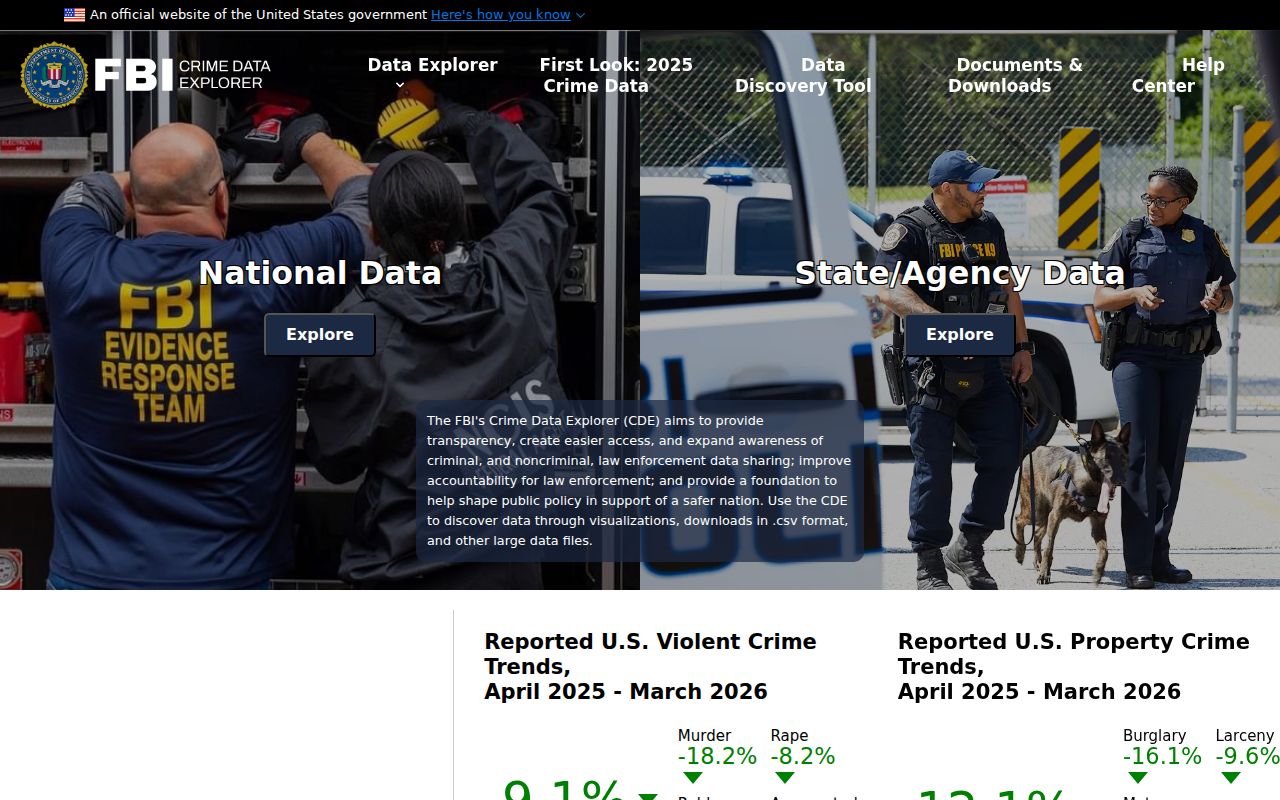
Always check agency participation and year completeness. A missing Camp Wood or Leakey row must not be interpreted as zero crime.
Real County Criminal Records by City
Real County has two incorporated cities, Camp Wood and Leakey. Neither city exposes a current official police records desk, municipal court portal, arrest blotter, or city jail roster in the researched sources. City-level work therefore begins with the named agency or court on existing paperwork, then moves to City Hall for municipal administrative records or to the Real County sheriff, clerk, and Justice Court for law-enforcement and case records.
Camp Wood Criminal Records
Population 517 in the 2020 Census. City Hall handles city administration; sheriff and county courts provide the documented criminal-record fallbacks.
Leakey Criminal Records
Population 315 in the 2020 Census. The county seat contains the courthouse, clerk, Justice Court, and sheriff contact system.
The Census county profile provides the population and geography context behind this consolidated records system. With residents spread across a large rural area, countywide searches and phone or counter fallbacks often reveal more than a strict city-name query.